How to Build a Training Matrix for a Domiciliary Care or Care Home Team
Learn how to build a care staff training matrix for care homes and domiciliary care teams, including records, renewals and competence.
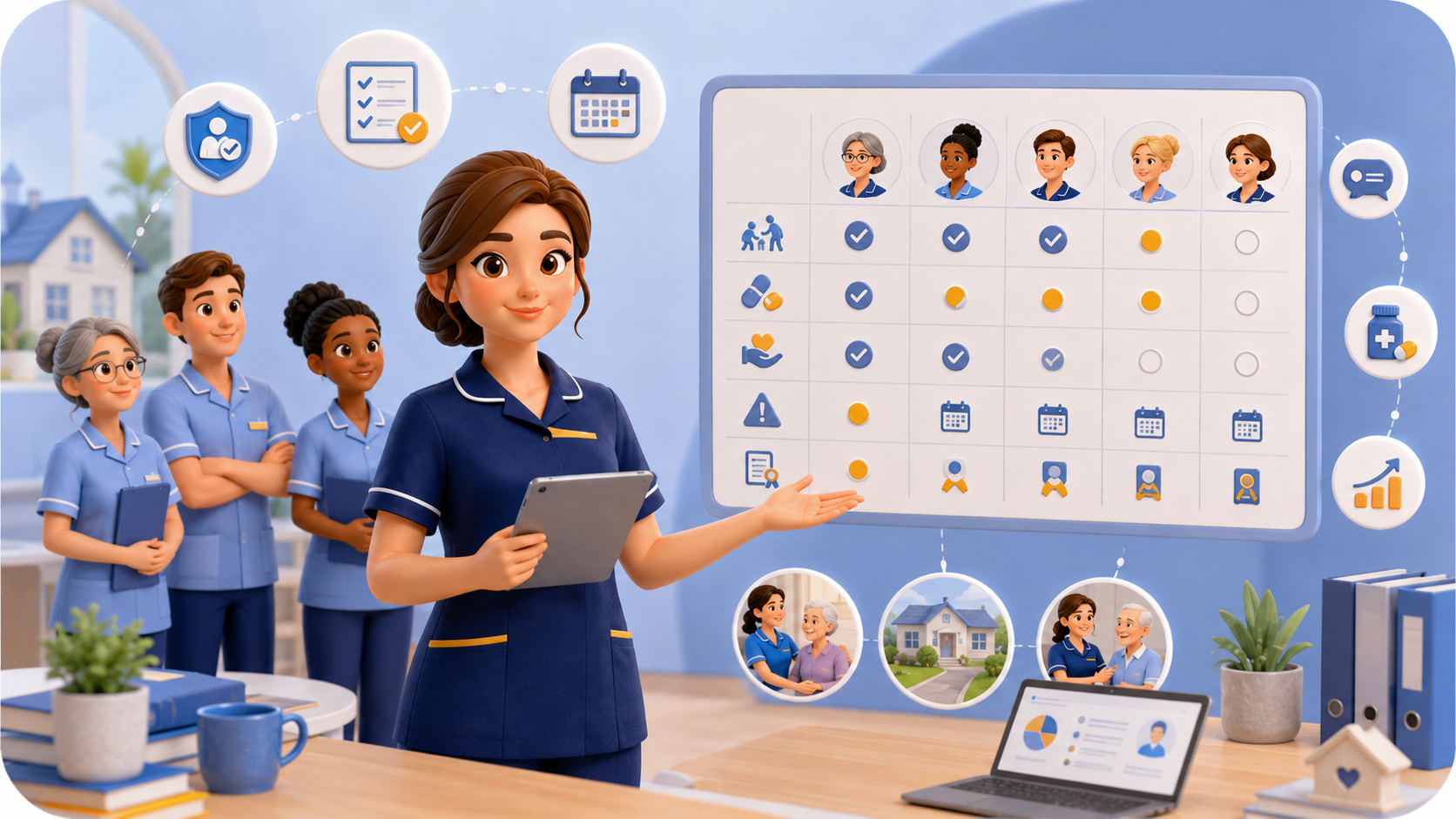
How to Build a Training Matrix for a Domiciliary Care or Care Home Team
A training matrix is one of the most useful compliance tools a care provider can have. Whether you run a domiciliary care service, care home, supported living service or nursing home, a clear training matrix helps you see who has completed training, what is overdue, what needs refreshing and where competence still needs to be signed off.
For registered managers, compliance leads and nominated individuals, a care staff training matrix is more than a spreadsheet. It is evidence that the provider has a system for monitoring staff training, competence, supervision and risk.
In England, CQC expects providers to deploy suitably qualified, competent, skilled and experienced staff. Providers must also support staff through appropriate training, supervision, appraisal and professional development. A well-maintained health and social care training matrix helps show how this is being managed in practice.
This guide explains how to build a training matrix for a care home or a domiciliary care training matrix, what columns to include, how to use it for compliance, and how to avoid common mistakes.
What Is a Training Matrix in Care?
A training matrix is a structured record that shows the training requirements for each member of staff. It helps managers track completed courses, renewal dates, missing training, competency sign-off and evidence locations.
A good mandatory training matrix for care staff should show:
- Who works for the service
- What role each person performs
- What training each role requires
- When each course was completed
- When training needs to be renewed
- Whether practical competence has been checked
- Who signed off the competence
- Where the evidence is stored
- What action is needed next
The purpose is simple: managers should be able to look at the matrix and quickly understand the training status of the whole team.
For example, a registered manager should be able to see whether all care assistants have completed safeguarding adults training, whether moving and handling practical assessments are up to date, whether medication competency checks have been signed off, and whether new starters have completed induction.
Why Care Providers Need a Training Matrix
Care providers need reliable systems for monitoring staff training and competence. Without a training matrix, training records can easily become scattered across certificates, emails, HR files, online platforms and paper folders.
A training matrix helps providers:
- Monitor mandatory training
- Identify overdue courses
- Plan refresher training
- Track new starter induction
- Evidence competence during inspection
- Link training to supervision and appraisal
- Reduce risk from expired training
- Support safer staffing decisions
- Show good governance
- Improve accountability across the service
For CQC-regulated services, a training matrix supports evidence around staffing, safe care, effective care and well-led governance. It helps show that training is not being managed informally or reactively, but through a clear system.
A good matrix also reduces pressure during inspection. Instead of searching through multiple files, managers can show a clear overview and then produce supporting evidence where required.
Legal and Compliance Considerations
A training matrix is not specifically required by one single law. However, it supports several important legal and regulatory duties.
CQC Regulation 18 focuses on staffing. Providers must ensure staff are suitably qualified, competent, skilled and experienced for their role, and that they receive appropriate training, supervision, professional development and appraisal.
CQC Regulation 17 focuses on good governance. Providers must have systems and processes to assess, monitor and improve the quality and safety of services. Training records, competency checks and action plans are part of this governance evidence.
Health and safety law also requires employers to provide workers with clear information, instruction, training and supervision to protect them and others affected by their work. This is particularly relevant to moving and handling, infection prevention, fire safety, COSHH, lone working and equipment use.
A training matrix helps bring these responsibilities together. It does not replace certificates, supervision records or competency assessments, but it helps managers monitor whether those records exist and whether they are up to date.
What Columns Should a Care Staff Training Matrix Include?
The best training matrix is simple enough to maintain but detailed enough to be useful. If it becomes too complicated, managers may stop updating it. If it is too basic, it may not provide enough evidence.
At a minimum, your matrix should include the following columns.
Staff Name
Record the staff member’s full name. This helps avoid confusion where there are staff with similar names.
Job Role
Include the person’s role, such as care assistant, senior carer, nurse, support worker, care coordinator, registered manager, nominated individual, cleaner, kitchen assistant or office administrator.
The role matters because training requirements should be role-specific.
Start Date
The start date helps managers monitor induction, probation and new starter training. It also helps identify whether a staff member should have completed certain training before working independently.
Employment Type
Include whether the person is permanent, part-time, bank, agency, self-employed, volunteer or contractor.
This is useful because agency workers and self-employed workers may have evidence from another source, but the provider still needs assurance that they are trained and safe for the work they are doing.
Mandatory Courses Required
List the required courses for the role. These may include safeguarding adults, moving and handling, infection prevention and control, medication awareness, health and safety, fire safety, food hygiene, Mental Capacity Act, equality and diversity, duty of care, record keeping, confidentiality and learning disability and autism awareness.
Completion Date
Record the date the course was completed. This should match the certificate or platform record.
Renewal Date
Record when training needs to be refreshed. This is one of the most important columns in a care home staff training tracker or domiciliary care staff training tracker because it allows managers to plan before training expires.
Training Status
Use simple statuses such as:
- Completed
- Due soon
- Overdue
- Not started
- In progress
- Not applicable
- Evidence requested
This makes it easy to filter and review the matrix.
Competency Sign-Off
Some subjects need more than course completion. Include a column showing whether practical competence has been checked and signed off.
This is especially important for:
- Medication support or administration
- Moving and handling
- Use of hoists or specialist equipment
- Infection prevention practice
- Food handling where relevant
- Clinical or delegated healthcare tasks
- Record keeping standards
- Basic life support where required
Competency sign-off in care training is important because a certificate alone may not show that a worker can apply the learning safely in practice.
Supervisor or Assessor
Record who completed the sign-off or reviewed the training. This may be a senior carer, team leader, nurse, registered manager, trainer or competent assessor.
Evidence Location
Record where the evidence is stored. This may be:
- Staff file
- Online learning platform
- HR system
- Shared drive
- Training folder
- Compliance system
- Medication competency folder
- Supervision record
- Care Certificate evidence folder
This column saves time during audits and inspections.
Notes or Actions
Use this column to record what needs to happen next. For example:
- Book moving and handling practical
- Awaiting certificate
- Repeat medication competency in four weeks
- Discuss at supervision
- New starter induction in progress
- Refresher due next month
- Evidence requested from agency
Suggested Training Matrix Layout
You can build the matrix in a spreadsheet, HR system, learning management system or compliance platform. The structure below is a practical starting point.
| Staff Name | Role | Start Date | Employment Type | Mandatory Course | Completion Date | Renewal Date | Status | Competency Sign-Off | Supervisor/Assessor | Evidence Location | Notes/Actions |
|---|---|---|---|---|---|---|---|---|---|---|---|
| Jane Smith | Care Assistant | 10/01/2026 | Permanent | Safeguarding Adults | 12/01/2026 | 12/01/2027 | Completed | Not required | Senior Carer | Online platform | Review annually |
| Jane Smith | Care Assistant | 10/01/2026 | Permanent | Moving and Handling | 13/01/2026 | 13/01/2027 | Practical due | Pending | Moving Handling Assessor | Staff file | Book practical assessment |
| Ahmed Khan | Senior Carer | 04/02/2026 | Permanent | Medication Awareness | 05/02/2026 | 05/02/2027 | Completed | Signed off | Registered Manager | Medication folder | Spot check in 3 months |
| Maria Jones | Nurse | 21/03/2026 | Agency | Infection Prevention | 22/03/2026 | 22/03/2027 | Evidence received | Signed off locally | Nurse Lead | Agency file | Local policy completed |
This format allows one row per staff member per course. It is useful because managers can filter by course, role, status, renewal date or assessor.
For smaller teams, some providers prefer one row per staff member with each course as a column. This can work, but it may become difficult to manage when there are many training topics and competency checks.
Step-by-Step Guide: How to Build a Training Matrix
Step 1: List Every Staff Member
Start with a complete staff list. Include permanent staff, part-time staff, bank workers, agency workers, self-employed workers, volunteers and contractors where relevant.
For domiciliary care services, make sure care coordinators, on-call staff, field supervisors and office staff are included. For care homes, include care staff, nurses, kitchen staff, housekeeping, maintenance, activities staff and management.
A training matrix is only reliable if it includes everyone who needs training.
Step 2: Define Training by Role
Do not give every staff member the same training list without thinking about their responsibilities.
A care assistant may need safeguarding, moving and handling, infection prevention, duty of care and record keeping. A senior carer may also need medication training, supervision skills and safeguarding escalation. A registered manager may need leadership, governance, safeguarding lead training and CQC compliance knowledge.
Role-specific training helps prevent two problems: under-training staff who carry out higher-risk tasks, and overloading staff with courses that are not relevant to their role.
Step 3: Identify Mandatory and Role-Specific Courses
Your mandatory training list may include:
- Safeguarding adults
- Moving and handling
- Medication awareness
- Infection prevention and control
- Health and safety
- Fire safety
- Food hygiene
- Mental Capacity Act and consent
- Equality, diversity and inclusion
- Duty of care
- Record keeping
- Confidentiality and data protection
- Basic life support
- Learning disability and autism awareness
- Dementia awareness
- Lone working
- COSHH
- Complaints and whistleblowing
Not every course applies to every role. For example, kitchen staff may need food hygiene at a different level from care staff, while staff who do not administer medication may need medication awareness rather than full medication competency sign-off.
Step 4: Set Renewal Dates
Decide how often each training topic should be refreshed. Some providers refresh key training annually. Other topics may be refreshed every two or three years depending on risk, policy, contractual requirements and local expectations.
High-risk topics should be reviewed regularly, including:
- Safeguarding
- Medication
- Moving and handling
- Infection prevention and control
- Fire safety
- Health and safety
- Food hygiene
- Basic life support
Refresher training may also be needed sooner if there is an incident, complaint, audit concern, policy change, equipment change or change in a person’s care needs.
Step 5: Add Competency Sign-Off Requirements
A strong matrix should track both training completion and competence.
For example, online medication training may show that a staff member understands the theory. However, medication competency assessment should check whether the worker can follow your medication policy, read MAR charts, record accurately, respond to refusals and escalate errors.
Moving and handling theory may be completed online, but staff who physically assist people should usually complete practical handling assessment.
Add competency sign-off columns for practical or higher-risk tasks so managers can see whether the worker is ready to perform the duty safely.
Step 6: Add Evidence Locations
A common inspection problem is not that training was missed, but that evidence cannot be found quickly.
For every course or competency check, record where the evidence is stored. This may be the online training platform, staff file, HR system, shared drive, supervision record or competency folder.
The evidence location column helps managers respond quickly during audits, commissioner checks or CQC inspection preparation.
Step 7: Review the Matrix Regularly
A training matrix should be a live management tool, not a file that is updated only before inspection.
Review it at least monthly, and more often if you have many staff, high turnover or frequent new starters.
During review, check:
- What is overdue?
- What is due in the next 30, 60 or 90 days?
- Which staff are still in induction?
- Which competency checks are pending?
- Which certificates are missing?
- Which staff should not perform certain tasks yet?
- What needs to be discussed in supervision?
This turns the matrix into an active compliance tool.
Step 8: Link the Matrix to Supervision and Appraisal
Training should be discussed during supervision and appraisal. Managers should use the matrix to identify learning needs, confidence issues, overdue courses and development goals.
For example, if a staff member has completed medication training but not yet had competency sign-off, this should be discussed before they support medication independently.
If a worker has repeated record keeping issues, refresher training and supervision should be recorded.
Step 9: Audit the Matrix
Periodically check the matrix against staff files and certificates. This helps ensure the matrix is accurate.
Audit questions may include:
- Does the certificate match the completion date?
- Is the renewal date correct?
- Has competency been signed off?
- Is the assessor named?
- Is the evidence stored where the matrix says it is?
- Are overdue items being acted on?
- Are agency worker records current?
- Are new starters progressing through induction?
This supports stronger training compliance for care providers.
Training Matrix for Domiciliary Care Teams
A domiciliary care training matrix should reflect the particular risks of care delivered in people’s own homes.
Additional considerations may include:
- Lone working
- Medication support in the home
- Moving and handling in domestic environments
- Use of equipment in different properties
- Safeguarding and domestic abuse awareness
- Fire safety in people’s homes
- Infection control between visits
- Missed or late visit reporting
- Record keeping in digital care planning systems
- Escalation when a person’s condition changes
- Out-of-hours reporting routes
Domiciliary care workers often work independently, so training evidence and competency checks are especially important. Managers should be confident that staff can make appropriate decisions, report concerns and follow care plans without constant supervision.
Training Matrix for Care Home Teams
A training matrix for care home teams should reflect the risks of a shared care environment.
Additional considerations may include:
- Fire drills and evacuation procedures
- Infection outbreak management
- Nutrition and hydration monitoring
- Falls prevention
- Pressure care awareness
- Medication rounds
- Dementia care
- Activities and wellbeing
- Night staff training
- Kitchen and housekeeping training
- Nurse-specific competencies where relevant
- Equipment use, including hoists and pressure-relieving equipment
Care homes usually have a wider range of staff roles, so the matrix should include non-care staff as well. Kitchen staff, housekeeping, maintenance and activities staff may all need training relevant to their duties.
Common Mistakes to Avoid
Using One Generic Training List for Everyone
A generic list may miss important role-specific risks. Training should be based on role, responsibility and service type.
Forgetting Competency Sign-Off
Course completion does not always prove competence. Medication, moving and handling, equipment use and clinical tasks often need practical sign-off.
Not Including Agency or Bank Staff
Agency and bank staff still need appropriate training evidence and local induction. Do not leave them outside your matrix.
Recording Completion Dates but Not Renewal Dates
A matrix without renewal dates will not help managers plan refresher training. Renewal dates are essential for compliance planning.
Not Recording Evidence Location
If managers cannot find evidence quickly, inspection preparation becomes stressful. Always record where certificates and assessments are stored.
Letting the Matrix Become Outdated
A matrix is only useful if it is maintained. Review it regularly and assign clear responsibility for updates.
Treating the Matrix as Evidence on Its Own
The matrix is an overview. It should be supported by certificates, induction records, competency assessments, supervision notes and other evidence.
Failing to Act on Gaps
It is not enough to identify overdue training. Managers should record what action has been taken, such as booking refresher training, restricting duties or arranging supervision.
FAQ: Care Staff Training Matrix
What is a training matrix for care staff?
A training matrix is a tracker that shows which staff need which training, when courses were completed, when they are due for renewal, whether competence has been signed off, and where evidence is stored.
What should be included in a care staff training matrix?
A good matrix should include staff name, role, start date, employment type, mandatory courses, completion date, renewal date, training status, competency sign-off, supervisor or assessor, evidence location and notes or actions.
Do care homes need a training matrix?
A training matrix is not named as a standalone legal requirement, but it is a very useful way to evidence training, competence and governance. It helps care homes show that staff training is monitored and managed.
Do domiciliary care providers need a training matrix?
Yes, a domiciliary care staff training tracker is strongly recommended. Domiciliary care workers often work alone, so providers need clear evidence that staff are trained, competent and supported.
How often should a training matrix be reviewed?
Many providers review the matrix monthly. Services with high staff turnover, frequent new starters or high-risk care needs may need to review it more often.
Is a certificate enough evidence of training?
A certificate is useful evidence of course completion, but it may not prove practical competence. Higher-risk tasks such as medication support and moving and handling should usually include competency sign-off.
Who should update the training matrix?
This depends on the provider. It may be updated by the registered manager, deputy manager, care coordinator, HR lead, compliance lead or training administrator. The key point is that responsibility should be clear.
Can online training be tracked in a matrix?
Yes. Online training is well suited to matrix tracking because completion dates and certificates can usually be recorded easily. Providers should still add practical assessment and competency sign-off where required.
How ACSTRA Can Support Your Training Matrix
ACSTRA provides online healthcare courses for care providers across the United Kingdom. Our online training can help you keep staff learning organised, support refresher training and strengthen your compliance evidence.
Whether you need a training matrix for care home staff, a domiciliary care training matrix, mandatory training for care workers or online healthcare courses to support induction and refresher learning, ACSTRA can help.
Explore available courses here:
Ready to start training?
For care providers who need support choosing suitable online training for their team, contact ACSTRA for guidance. We can help you identify appropriate courses based on staff roles, service type and compliance needs.