Top 10 Online Courses Every Care Provider Should Offer Their Staff
Discover 10 online care courses every care provider should offer staff to support compliance, safer care and staff development.
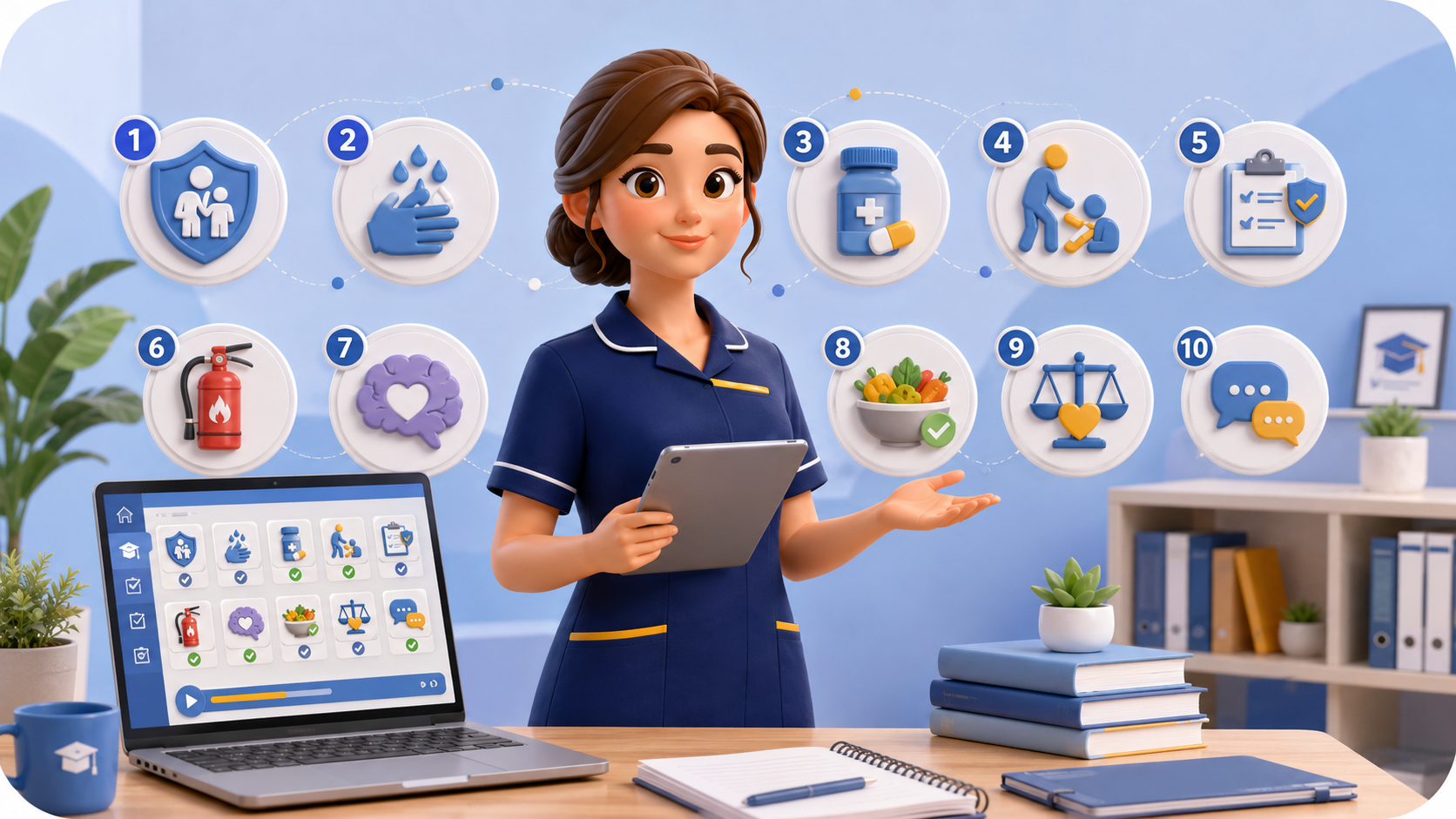
Top 10 Online Courses Every Care Provider Should Offer Their Staff
Online training is now an essential part of staff development in health and social care. For care homes, domiciliary care agencies, supported living services and healthcare providers, online courses can help staff build knowledge, refresh important subjects and maintain clearer training records.
For care providers, training is not just about ticking a box. Staff need to understand their responsibilities, recognise risk, follow policies and apply learning in practice. The right online care courses can support safer care, stronger compliance evidence and better staff confidence.
In England, providers must make sure staff are suitably trained, competent, supervised and supported for their roles. This means care provider staff training should be planned carefully, reviewed regularly and linked to the needs of the people receiving care.
This guide explains the top 10 mandatory care training courses every care provider should consider, when online training is suitable, and where practical assessment or workplace competence checks may also be needed.
Why Online Training Matters for Care Providers
Online training for care staff is popular because it is flexible, consistent and easy to track. Staff can complete learning around shifts, managers can monitor completion dates, and providers can keep clearer evidence for audits, supervision and inspection preparation.
Online learning is especially useful for knowledge-based subjects. It can help staff understand legal duties, common risks, reporting routes, safe practice principles and professional responsibilities.
For care providers, online courses can support:
- New starter induction
- Mandatory training
- Refresher training
- Staff development
- Training matrix completion
- Evidence for inspection
- Consistent learning across teams
- Reduced time away from care duties
- CPD and career development
- Safer working practices
However, online training should be used properly. Some areas, such as moving and handling practice or medication administration, may require practical assessment, observation or competency sign-off. A certificate proves that learning was completed, but it does not always prove that a worker is competent in practice.
The safest approach is to use online training for knowledge and add workplace assessment where practical skills are required.
Choosing the Right Online Care Courses
Before choosing courses, care providers should think about role, risk and service type. A care home, domiciliary care agency and supported living service may all need similar core subjects, but the way staff apply the learning may differ.
For example, infection prevention in a care home may focus on shared spaces, laundry, waste and outbreak management. Infection control in domiciliary care may focus more on moving safely between homes, PPE use, hand hygiene between visits and reporting environmental concerns.
A good training plan should reflect:
- The regulated activity
- The care setting
- Staff roles
- People’s care and support needs
- Risk assessments
- Local policies
- Contractual requirements
- CQC expectations
- Practical competency requirements
- Refresher training dates
The following 10 courses are a strong starting point for most care providers.
1. Safeguarding Adults Online Course
A safeguarding adults online course is one of the most important courses for care staff. Every worker should understand how to recognise abuse, report concerns and protect people from harm.
Safeguarding adults training should cover:
- Types of abuse and neglect
- Physical, emotional, sexual and financial abuse
- Domestic abuse and modern slavery
- Self-neglect and organisational abuse
- Recognising signs of concern
- Responding to disclosures
- Recording concerns accurately
- Escalation and reporting
- Whistleblowing
- Professional curiosity
- Local safeguarding procedures
Safeguarding is relevant to care assistants, senior carers, nurses, managers, office staff and agency workers. The depth of training should match the person’s role. For example, a registered manager may need more advanced knowledge of safeguarding referrals, allegations against staff and working with local safeguarding partners.
Online safeguarding training works well as a foundation, but providers should also check that staff know the local reporting process and who to contact in an emergency.
2. Moving and Handling Training
Moving and handling training helps staff understand how to support people safely while reducing the risk of injury to both the person receiving care and the worker.
Online moving and handling training can cover:
- Basic anatomy and posture
- Risk assessment
- Unsafe techniques
- Safer movement principles
- Equipment awareness
- Person-centred handling
- Reporting changes in mobility
- Staff responsibilities
However, moving and handling is a practical area. If staff physically support people to move, online theory should be followed by hands-on training, observation and competency sign-off.
This is especially important where staff use hoists, slings, slide sheets, transfer aids, wheelchairs or specialist equipment. A worker may understand the theory but still need feedback on technique, positioning and safe use of equipment.
3. Medication Awareness Training
Medication awareness training is essential for care staff who prompt, support, administer or record medication. Medication errors can cause serious harm, so staff must understand safe handling and escalation.
Medication awareness training should cover:
- Types of medication
- Medication labels
- Administration routes
- MAR charts
- PRN medication
- Medication refusals
- Medication errors
- Controlled drugs awareness
- Covert medication awareness
- Safe storage
- Consent and mental capacity
- Reporting and escalation
Online medication awareness is useful for knowledge, but it should not be the only step for staff who administer medication. Providers should also complete local medication policy training and medication competency assessment.
For example, staff should be assessed on whether they can read a MAR chart, check the right person, medicine, dose, time and route, record accurately and respond properly to refusals or errors.
4. Infection Prevention and Control Training
Infection prevention and control training helps staff reduce the spread of infection and protect people at higher risk.
This course should cover:
- How infections spread
- Hand hygiene
- PPE use
- Cleaning and disinfection
- Laundry handling
- Waste management
- Respiratory hygiene
- Food hygiene links
- Outbreak awareness
- Reporting symptoms
- Staff responsibilities
Online IPC training is suitable for induction and refresher learning. However, providers should also observe practice. Managers may need to check hand hygiene, PPE use, cleaning routines, waste disposal and outbreak procedures.
This training is important for care homes, domiciliary care, supported living and healthcare settings. It should be refreshed regularly and updated when guidance or local procedures change.
5. Health and Safety Training
Health and safety training helps staff understand workplace risks and their responsibility to keep themselves and others safe.
A health and safety online course should cover:
- Risk assessment
- Accident reporting
- Slips, trips and falls
- Lone working
- COSHH awareness
- Equipment safety
- Workplace hazards
- Manual handling awareness
- Emergency procedures
- Reporting unsafe practice
In care settings, health and safety is not limited to the building. Domiciliary care workers may face risks in people’s homes, including pets, smoking, poor lighting, unsafe furniture, infection risks or environmental hazards.
Online health and safety training should be supported by local procedures, risk assessments and supervision.
6. Fire Safety Training for Care Staff
Fire safety training for care staff is essential in care homes, supported living, domiciliary care and healthcare services.
Fire safety training should cover:
- Fire prevention
- Common fire risks
- Raising the alarm
- Evacuation principles
- Emergency exits
- Fire doors
- Fire extinguishers awareness
- Personal emergency evacuation plans where relevant
- Reporting hazards
- Local fire procedures
In care homes and supported living, fire safety may involve supporting people who cannot evacuate independently. Staff should understand local evacuation procedures, alarm systems, fire doors and individual support plans.
For domiciliary care workers, training should include recognising fire risks in people’s homes and reporting concerns, such as unsafe smoking, overloaded plugs or blocked exits.
Online fire safety training is useful for awareness, but providers may also need site-specific induction, drills and local procedure training.
7. Food Hygiene Training
Food hygiene training is important for staff who prepare, handle, serve or support people with food and drink.
Food hygiene training should cover:
- Hand hygiene before food handling
- Safe food storage
- Temperature control
- Avoiding cross-contamination
- Cleaning food preparation areas
- Allergens
- Reporting illness
- Safe support with eating and drinking
- Food waste
- Nutrition and hydration links
Food hygiene in care is closely linked to dignity, safety and wellbeing. Staff may also need to understand special diets, choking risks, diabetes, allergies, cultural preferences and hydration concerns.
Online food hygiene training can provide a strong knowledge base, but providers should still monitor kitchen practice, food handling and recording where relevant.
8. Mental Capacity Act and DoLS/LPS Awareness
Care staff should understand the Mental Capacity Act, consent and least restrictive practice. This is particularly important when supporting people with dementia, learning disabilities, brain injuries, mental health needs or fluctuating capacity.
Training should cover:
- The five principles of the Mental Capacity Act
- Consent
- Decision-specific capacity
- Best interests
- Unwise decisions
- Least restrictive options
- Deprivation of liberty awareness
- Recording concerns
- Escalation
Many staff do not need to make formal capacity assessments, but they do need to understand how the Mental Capacity Act affects day-to-day care. For example, staff should know how to respond when a person refuses care, refuses medication or makes a decision that others consider unwise.
Online training works well for awareness, but providers should use supervision and case discussions to help staff apply the principles in real care situations.
9. Equality and Diversity Training
Equality and diversity training helps staff provide respectful, inclusive and person-centred care.
Training should cover:
- Protected characteristics
- Discrimination
- Dignity and respect
- Inclusive communication
- Cultural awareness
- Unconscious bias
- Person-centred support
- Challenging discriminatory behaviour
- Respecting individual preferences
This course is relevant to every role. Care workers support people from different backgrounds, with different beliefs, identities, needs and preferences. Staff should understand how to avoid assumptions and deliver care that respects the individual.
Online equality and diversity training can be supported by supervision, team discussion and person-centred care planning.
10. Duty of Care Training
Duty of care training helps staff understand their professional responsibilities and boundaries.
Training should cover:
- What duty of care means
- Accountability
- Acting in the person’s best interests
- Managing dilemmas
- Reporting concerns
- Confidentiality
- Whistleblowing
- Professional boundaries
- Record keeping
- Complaints awareness
Duty of care is especially useful for new care workers because it helps them understand the seriousness of their role. It also supports staff who work alone, such as domiciliary care workers and supported living staff.
Online duty of care training can be included in induction and refreshed as part of CPD.
How These Courses Support Compliance
Care provider staff training should support safe care, effective care and good governance. The 10 courses above help providers cover key areas of risk, but training should not be treated as a one-off event.
Providers should be able to show:
- Which training each role requires
- When staff completed training
- When refresher training is due
- Whether staff understand local policies
- Whether practical competence has been checked
- How training gaps are managed
- How incidents lead to learning
- How training links to supervision and appraisal
A training matrix is useful for keeping this organised. It should include staff names, roles, courses, completion dates, renewal dates, competency sign-off, supervisor or assessor and evidence location.
Step-by-Step Guide: Building Your Online Training Plan
Step 1: Identify Your Service Type
Start by reviewing your setting. A care home, domiciliary care agency, supported living service and nursing service may all need different training arrangements.
Think about the people you support, their risks, staff duties, equipment used, medication responsibilities and safeguarding needs.
Step 2: List Every Staff Role
Include care assistants, senior carers, nurses, support workers, care coordinators, registered managers, nominated individuals, office staff, kitchen staff, cleaners, agency workers and bank staff.
Each role should have a training requirement based on what the person actually does.
Step 3: Choose Core Mandatory Courses
Use the 10 courses in this guide as a starting point. Then add any specialist training your service needs, such as dementia care, learning disability and autism awareness, end-of-life care, mental health, diabetes, epilepsy, falls prevention or pressure care.
Step 4: Decide What Can Be Completed Online
Knowledge-based training usually works well online. This includes safeguarding awareness, duty of care, infection prevention theory, fire safety awareness, equality and diversity, Mental Capacity Act awareness and health and safety awareness.
Practical areas may need additional assessment.
Step 5: Add Competency Checks Where Needed
Medication support, moving and handling, equipment use and some clinical tasks should include practical competence checks.
A certificate is useful, but competence should be confirmed before staff perform higher-risk tasks independently.
Step 6: Keep Clear Evidence
Keep certificates, training matrix records, induction records, competency assessments, supervision notes, refresher training logs and action plans for gaps.
Evidence should be easy to find and regularly reviewed.
Step 7: Review Training Regularly
Review your training plan after incidents, complaints, safeguarding concerns, medication errors, infection outbreaks, policy changes or changes in people’s care needs.
This helps keep training relevant and supports continuous improvement.
Common Mistakes to Avoid
Treating Online Training as a Tick-Box Exercise
Online training is valuable, but it should lead to safer practice. Managers should check that staff understand and apply the learning.
Giving Every Role the Same Training
A care assistant, nurse, senior carer, office worker and registered manager may need different training. Match courses to role and responsibility.
Forgetting Practical Assessment
Moving and handling and medication support often need practical assessment or competency sign-off. Online training alone may not be enough.
Letting Training Expire
Expired training creates avoidable compliance risk. Use a training matrix to track renewal dates and plan refresher training early.
Not Linking Training to Local Policies
Online courses are usually general. Staff still need to understand your provider’s local policies, reporting routes and procedures.
Poor Evidence Management
If training has been completed but evidence cannot be found, managers may struggle during audits or inspection preparation. Keep records organised.
Not Learning from Incidents
If the same problems keep happening, review training, supervision and competence. Incidents should lead to learning and improvement.
FAQ: Online Care Courses for Care Providers
What are the most important online care courses for staff?
The most important online care courses usually include safeguarding adults, moving and handling theory, medication awareness, infection prevention and control, health and safety, fire safety, food hygiene, Mental Capacity Act awareness, equality and diversity, and duty of care.
Are online courses accepted for care staff training?
Yes, online courses are widely used for care staff training, especially for knowledge-based topics. Providers should still add practical assessment where staff perform hands-on or higher-risk tasks.
What mandatory care training courses should providers offer?
Mandatory care training courses depend on the service type, staff role and risks involved. Common subjects include safeguarding, moving and handling, medication awareness, infection prevention, health and safety, fire safety, food hygiene, Mental Capacity Act, equality and diversity and duty of care.
Is online moving and handling training enough?
Online moving and handling training can cover theory, but staff who physically assist people usually need practical moving and handling training and competency assessment.
Is online medication awareness training enough?
Medication awareness training can be completed online, but staff who administer or support medication should also complete local policy training and medication competency assessment.
How often should care staff complete refresher training?
Refresh periods depend on provider policy, risk level, contractual requirements and changes in guidance. High-risk areas such as safeguarding, medication, moving and handling, infection prevention and fire safety should be reviewed regularly.
How should care providers track online training?
Providers should use a training matrix or learning management system to track courses, completion dates, renewal dates, competency checks and evidence location.
Can online courses support CPD?
Yes, online courses can support CPD when they are relevant to the worker’s role and development needs. They can help staff refresh knowledge, develop confidence and prepare for further responsibility.
How ACSTRA Can Support Online Care Training
ACSTRA provides health and social care online courses for care providers across the United Kingdom. Our online training can support induction, mandatory training, refresher learning, compliance evidence and staff development.
Whether you need online care courses for new starters, care provider staff training for an existing team, or mandatory care training courses to strengthen your training matrix, ACSTRA can help.
Explore available courses here:
Ready to start training?
For care providers who need support choosing suitable online training for care staff, contact ACSTRA for guidance. We can help you identify appropriate courses based on your service type, staff roles and compliance needs.