What Should a Care Home Training Matrix Include to Stay CQC Compliant?
Learn what a care home training matrix should include to support CQC compliance, staff records and training evidence.
What Should a Care Home Training Matrix Include to Stay CQC Compliant?
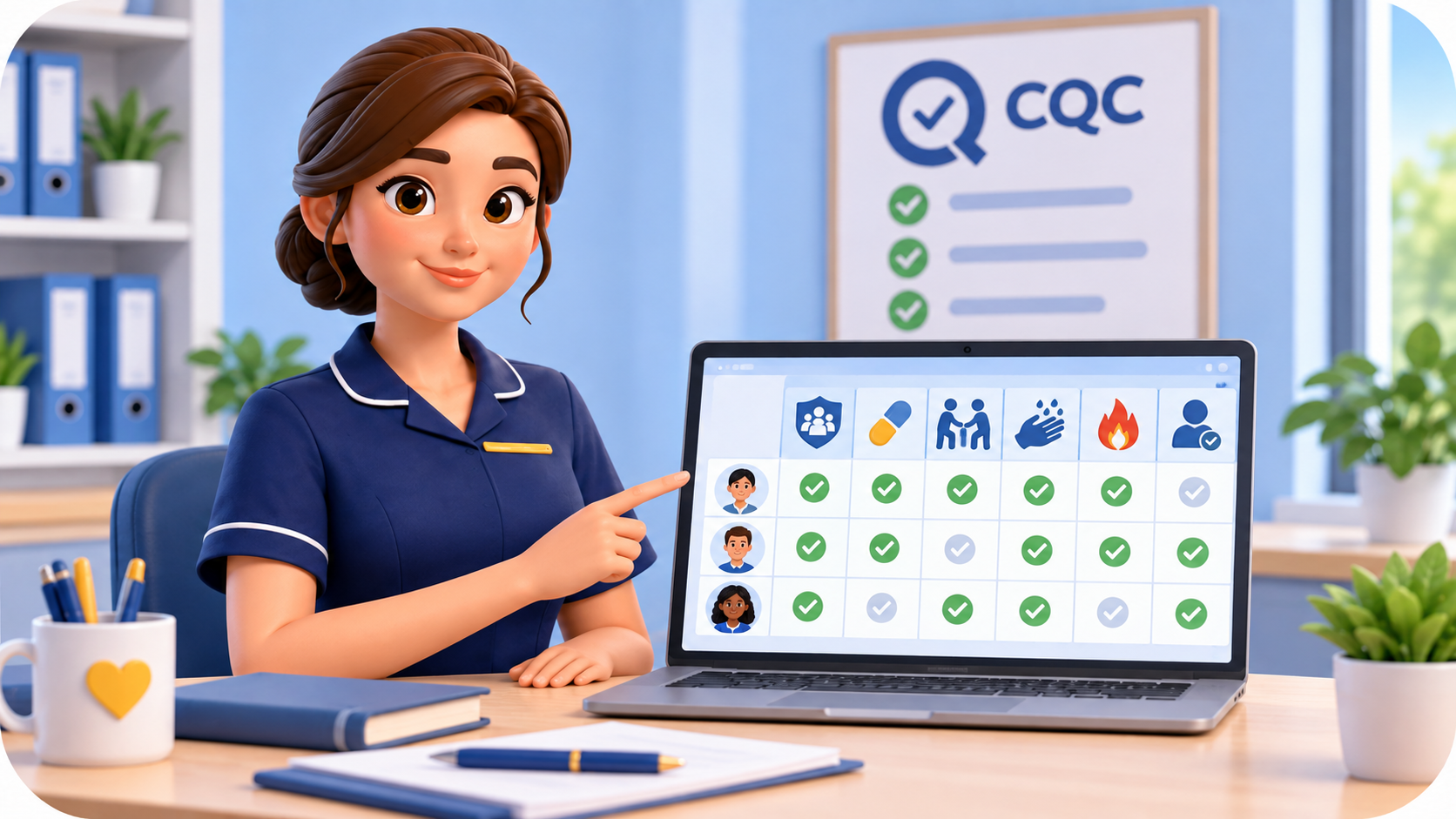
A care home training matrix is one of the most useful tools for managing staff training, competence and compliance evidence. It helps managers see who has completed training, what is overdue, when refreshers are due, and whether staff have been signed off as competent for key duties.
For care homes, training records are not just administrative documents. They help evidence that staff are suitably trained, supported and competent to meet people’s needs safely. A clear care home training matrix can support CQC inspection preparation, internal audits, supervision, appraisals and day-to-day workforce planning.
CQC Regulation 18 expects providers to deploy enough suitably qualified, competent, skilled and experienced staff, and to provide the training, support, supervision, professional development and appraisal needed for staff to carry out their duties. Regulation 17 also links to good governance, including effective systems and accurate records.
This guide explains what a CQC compliant training matrix should include, how to organise care home staff training records, and how managers can build a stronger staff training audit trail.
Why a Care Home Training Matrix Matters
A training matrix gives managers a single overview of staff training across the care home. Without one, training evidence can become scattered across certificates, emails, staff files, online platforms and spreadsheets.
A good care staff training matrix helps managers:
- Track mandatory training records
- Monitor refresher and renewal dates
- Identify overdue training
- Evidence role-specific training
- Record competency sign-off records
- Support safe staffing decisions
- Prepare for CQC assessment
- Plan supervision and appraisal discussions
- Identify learning needs after incidents
- Keep a clear staff training audit trail
For care homes, this is especially important because staff may support people with complex needs, dementia, medication, mobility risks, nutrition and hydration needs, infection risks, safeguarding concerns and end-of-life care needs.
The matrix helps show that training is not being managed reactively. It shows that the provider has a system.
What Does CQC Expect Around Training Records?
CQC does not require every provider to use the same training matrix format. However, providers should be able to evidence that staff are trained, competent and supported for their roles.
A care home should be able to show:
- Which training each staff member needs
- Which training has been completed
- Which training is overdue
- When refresher training is due
- Whether competency checks have been completed
- Whether staff have received induction
- Whether staff are supervised and supported
- Whether training reflects people’s care needs
- Whether action is taken when gaps are identified
A matrix should not simply be a list of course titles. It should help managers evidence competence, role suitability and ongoing development.
Core Details to Include in a Care Home Training Matrix
A strong care home training matrix should include enough detail to be useful during inspection, audit or management review.
At minimum, include:
- Staff name
- Job role
- Employment type
- Start date
- Mandatory training required
- Training completion date
- Refresher or renewal date
- Training status
- Certificate or evidence location
- Competency sign-off where required
- Assessor or supervisor name
- Notes or actions
- Date last reviewed
This structure gives managers a quick overview of both training completion and training gaps.
Staff Name, Role and Employment Type
Every staff member should be included in the matrix. This includes permanent staff, part-time staff, bank staff, agency staff, nurses, care assistants, senior carers, kitchen staff, domestic staff, activities staff, office staff and managers.
The role column is important because not every person needs the same training. A senior carer may need medication competency and supervision training, while a kitchen assistant may need food hygiene, infection prevention and health and safety.
Employment type is also useful because bank and agency staff can be missed. If they work in the care home, they still need appropriate checks, induction and evidence for the duties they perform.
Mandatory Training Records
Mandatory training records should be clearly shown in the matrix. These are the core subjects the provider requires staff to complete.
Common care home mandatory training may include:
- Safeguarding adults
- Moving and handling
- Medication awareness
- Infection prevention and control
- Health and safety
- Fire safety
- Food hygiene
- Mental Capacity Act and consent
- Equality, diversity and inclusion
- Duty of care
- Record keeping
- Confidentiality and data protection
- Basic life support where relevant
- Dementia awareness where relevant
- Learning disability and autism awareness where relevant
- End-of-life care where relevant
- Pressure care awareness where relevant
- Nutrition and hydration where relevant
The exact list should depend on the care home’s service type, residents’ needs, staff roles, provider policy and risk assessments.
Training Renewal Dates
Training renewal dates are essential. A training matrix is much less useful if it only shows completion dates.
Each training subject should have:
- Completion date
- Expiry or renewal date
- Current status
- Date refresher completed
- Action if overdue
Renewal dates help managers plan training before it expires. This is especially important for high-risk topics such as safeguarding, medication, moving and handling, infection prevention, fire safety and health and safety.
Refresher periods should be based on provider policy, role risk, legislation, guidance, contractual expectations and the needs of residents. Some topics may be refreshed annually, while others may have different review periods.
Competency Sign-Off Records
Certificates are useful, but they do not always prove competence. Some tasks require practical assessment.
Competency sign-off records should be included in the training matrix or clearly linked from it.
Competency checks may be needed for:
- Medication administration
- Moving and handling
- Hoist and sling use
- Infection prevention practice
- Food handling
- Record keeping
- Basic life support where relevant
- Pressure care where relevant
- Delegated healthcare tasks
- Use of specialist equipment
- Supporting people with complex needs
The matrix should show whether competency is complete, pending, overdue or restricted.
For example, a staff member may have completed medication awareness training but may not be authorised to administer medication until their competency assessment has been completed and signed off.
Evidence Location
A matrix should tell managers where the evidence can be found. This is important because during an audit or inspection, it should be easy to locate certificates, competency checks and induction records.
Evidence may be stored in:
- Online learning platform
- Staff file
- HR system
- Training folder
- Shared compliance drive
- Medication competency file
- Moving and handling assessment file
- Supervision folder
The matrix should include a simple evidence location column. For example: “LMS certificate”, “staff file”, “medication folder” or “digital HR record”.
Induction and Care Certificate Evidence
A care home training matrix should include induction evidence, especially for new care staff.
Induction records may include:
- Induction checklist
- Care Certificate evidence where applicable
- Shadowing records
- Local policy training
- Probation review
- Initial supervision
- Competency checks
- Manager sign-off
For new care workers, the Care Certificate may form part of induction, but it should be supported by workplace assessment and local procedures.
The matrix should show whether induction is complete and whether the staff member has been signed off to work independently.
Role-Specific and Specialist Training
A CQC compliant training matrix should reflect the needs of people living in the care home. Generic mandatory training alone may not be enough.
Role-specific and specialist training may include:
- Dementia care
- End-of-life care
- Learning disability and autism
- Mental health awareness
- Diabetes awareness
- Epilepsy awareness
- Falls prevention
- Pressure ulcer prevention
- Nutrition and hydration
- Dysphagia awareness
- Positive behaviour support
- De-escalation
- Sensory impairment awareness
- Safeguarding leadership
- Supervision and appraisal training
- Care planning
- Risk assessment
If the care home supports residents living with dementia, staff training should reflect this. If staff support people with learning disabilities, autism, complex medication needs or end-of-life care needs, the matrix should show relevant training.
Supervision and Appraisal Links
The training matrix should connect to supervision and appraisal records. Training should not be managed separately from staff support.
Supervision should discuss:
- Training completed
- Training still required
- Confidence and support needs
- Competency concerns
- Incidents or near misses
- Policy understanding
- Professional development
- Refresher training
- Actions agreed
Appraisal should review longer-term development, performance and career goals.
The matrix does not need to include every supervision note, but it should help managers identify what needs to be discussed.
Staff Training Audit Trail
A strong staff training audit trail shows what the provider knew, when it knew it, and what action it took.
For example, if training is overdue, the matrix should show:
- Training gap identified
- Date identified
- Action planned
- Responsible person
- Temporary restrictions where needed
- Completion date
- Review date
This matters because identifying a gap is only the first step. Managers should also show how they managed the risk.
If a staff member’s moving and handling competency is overdue, the care home may need to restrict that worker from certain tasks until reassessment is complete.
Suggested Care Home Training Matrix Layout
A practical matrix may include the following columns:
- Staff name
- Job role
- Start date
- Employment type
- Induction completed
- Care Certificate completed where applicable
- Safeguarding adults
- Moving and handling
- Medication awareness
- Medication competency
- Infection prevention and control
- Health and safety
- Fire safety
- Food hygiene
- Mental Capacity Act
- Equality and diversity
- Duty of care
- Record keeping
- Dementia care
- Learning disability and autism
- Specialist training required
- Last supervision date
- Next training renewal date
- Evidence location
- Notes and actions
- Manager review date
The matrix can be built in a spreadsheet, HR system or learning management system. The format is less important than accuracy, completeness and regular review.
Step-by-Step Guide: Building a CQC Compliant Training Matrix
Step 1: List Every Staff Member
Start with a complete staff list. Include all roles, including bank, agency and non-care staff.
Do not limit the matrix to care assistants only.
Step 2: Define Training by Role
Create a role-based training plan. Decide what each role needs based on duties, resident needs and risk.
For example, senior carers may need medication competency and supervision training, while domestic staff may need COSHH, infection prevention and health and safety.
Step 3: Add Mandatory Training Subjects
Add core mandatory training subjects to the matrix. These should reflect provider policy, legislation, guidance and care home risks.
Step 4: Add Specialist Training
Review residents’ needs and add specialist training where relevant. This may include dementia, end-of-life care, diabetes, falls, pressure care, learning disability and autism, or mental health.
Step 5: Record Completion and Renewal Dates
Add completion dates and renewal dates for every course. This helps managers plan refresher training early.
Step 6: Link Competency Checks
Add competency sign-off columns for medication, moving and handling, equipment use and other practical tasks.
Do not rely only on certificates where practical competence is required.
Step 7: Add Evidence Locations
Record where certificates, assessments and induction records are stored.
This makes audits and inspections easier.
Step 8: Review the Matrix Regularly
Review the matrix at least monthly, or more often if you have new starters, high staff turnover or known training gaps.
Step 9: Act on Gaps
If training is overdue or competence is not signed off, record the action taken.
This may include refresher training, supervision, reassessment, temporary restrictions or additional support.
Step 10: Use the Matrix in Governance Meetings
Use the matrix in management reviews, quality audits and governance meetings. This helps training become part of quality assurance, not just administration.
Common Mistakes to Avoid
Keeping Completion Dates but No Renewal Dates
Completion dates are useful, but renewal dates are what help managers prevent training from expiring.
Treating Certificates as Competency Evidence
A certificate proves a course was completed. It does not always prove that staff can apply the learning safely in practice.
Forgetting Bank and Agency Staff
Bank and agency staff must be included where they work in the service. They need appropriate induction, training checks and evidence.
Using the Same Training List for Everyone
Training should reflect role and responsibility. A nurse, senior carer, care assistant, domestic assistant and manager may all need different training.
Not Linking Training to Resident Needs
A care home supporting people with dementia should show dementia training. A care home supporting people with complex medication needs should show medicines competence.
Not Recording Actions for Gaps
If a matrix shows overdue training but no action, it may weaken compliance evidence. Always record what is being done.
Keeping Evidence in Too Many Places
Scattered evidence can make audits stressful. Use the matrix to show exactly where each record is stored.
Not Reviewing the Matrix Regularly
A training matrix should be a live document. If it is only updated before inspection, it may not reflect current risk.
FAQ: Care Home Training Matrix
What is a care home training matrix?
A care home training matrix is a document or system that tracks staff training requirements, completion dates, renewal dates, competency checks and evidence locations.
What should a CQC compliant training matrix include?
It should include staff names, roles, mandatory training, completion dates, renewal dates, training status, competency sign-off records, evidence locations, notes, actions and review dates.
Is a training matrix required by CQC?
CQC does not require one specific format, but providers should be able to evidence staff training, competence, supervision and governance. A training matrix is a practical way to organise this evidence.
What mandatory training records should care homes keep?
Care homes should keep records for training such as safeguarding, moving and handling, medication, infection prevention, health and safety, fire safety, food hygiene, Mental Capacity Act, equality and diversity, duty of care, record keeping and any specialist training required.
Are certificates enough for CQC training compliance?
No. Certificates are useful, but higher-risk tasks may also need competency checks, observations, supervision records and practical sign-off.
How often should a care home training matrix be reviewed?
Many care homes review the matrix monthly. It should also be reviewed after new starters, role changes, incidents, complaints, audits or changes in residents’ needs.
What are competency sign-off records?
Competency sign-off records show that a staff member has been assessed as able to carry out a task safely in practice. They are commonly used for medication, moving and handling and specialist tasks.
What is a staff training audit trail?
A staff training audit trail shows training requirements, completion, gaps, actions taken, evidence locations and review dates. It helps managers demonstrate that training is actively managed.
How ACSTRA Can Support Care Home Training Records
ACSTRA provides online healthcare courses for care providers across the United Kingdom. Our online training can support mandatory training records, refresher learning, induction and care home training evidence.
Whether you need a care home training matrix, online courses for care staff, refresher training or support with CQC training compliance, ACSTRA can help.
Explore available courses here:
Ready to start training?
For care home providers who need support choosing suitable online training for staff, contact ACSTRA for guidance. We can help you identify appropriate courses based on staff roles, resident needs and compliance requirements.