What Training Records Should Care Providers Keep for CQC Inspection?
Learn what training records care providers should keep for CQC inspection, including certificates, competency checks and matrices.
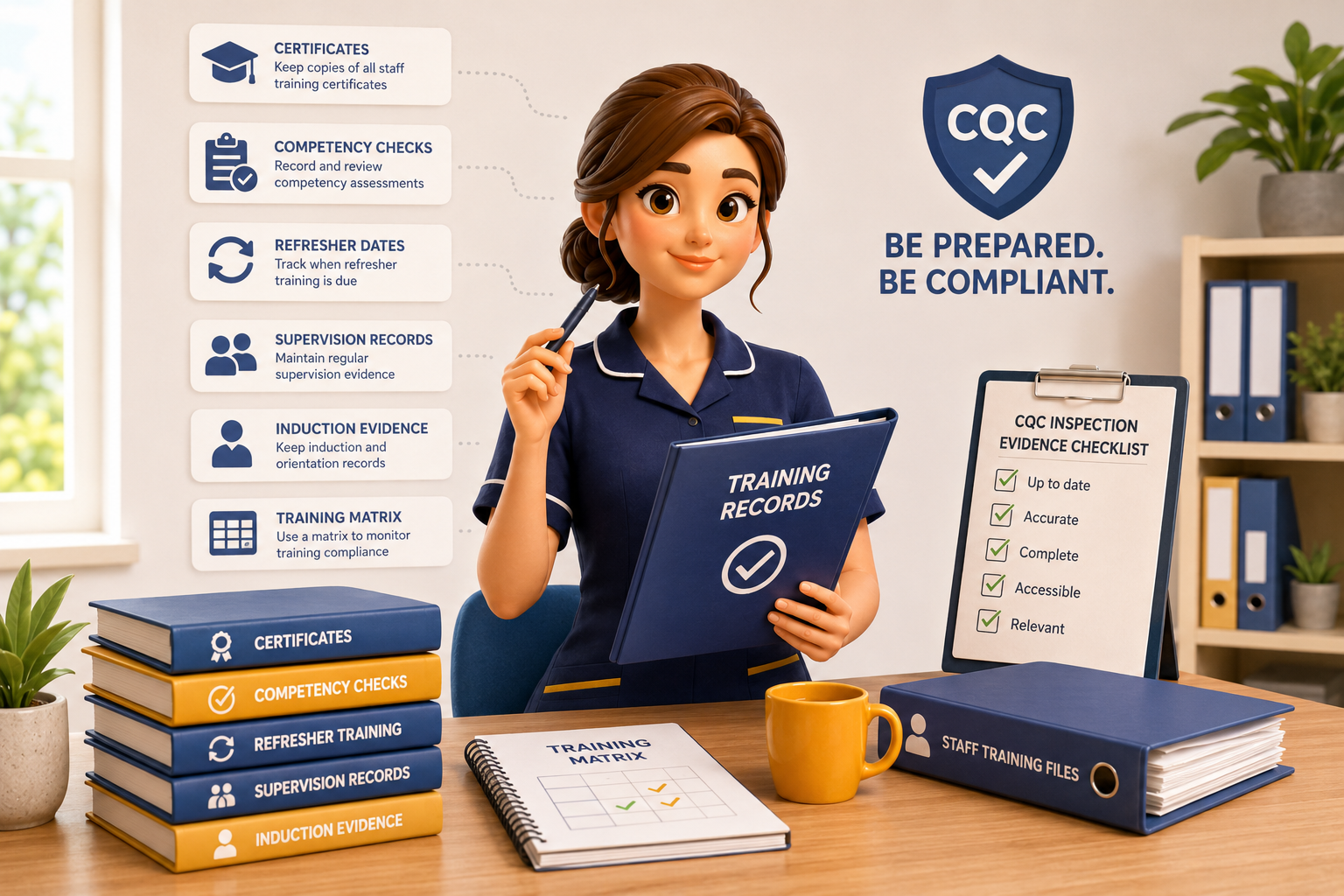
What Training Records Should Care Providers Keep for CQC Inspection?
Training records are a key part of CQC inspection evidence. For care providers, it is not enough to say that staff have been trained. You need to show clear, organised and up-to-date evidence that staff have completed the right training, refreshed it when required, and can apply it safely in practice.
Whether you run a care home, domiciliary care agency, supported living service, nursing service or healthcare provider, your care staff training records should show that staff are suitably trained, competent and supported for their roles.
CQC Regulation 18 expects providers to deploy enough suitably qualified, competent, skilled and experienced staff, and to make sure staff receive appropriate support, training, professional development, supervision and appraisal. Regulation 17 also expects providers to have effective systems to assess, monitor and improve quality and safety, while Regulation 19 links recruitment and staffing to qualifications, competence, skills and experience. :contentReference[oaicite:0]{index=0}
This guide explains what training records for CQC inspection care providers should keep, how to organise them, and how to avoid common evidence gaps.
Why Training Records Matter During CQC Inspection
CQC’s assessment framework asks whether services are safe, effective, caring, responsive and well-led. Training records can support evidence across several of these areas, particularly safe, effective and well-led care. :contentReference[oaicite:1]{index=1}
Inspectors may want to understand whether staff:
- Have completed required training
- Are competent for their duties
- Have received induction
- Receive supervision and appraisal
- Have refresher training when needed
- Understand local policies and procedures
- Are supported after incidents or concerns
- Have training linked to the needs of people using the service
Good CQC training evidence helps show that the provider has a system for managing staff learning and competence. It also helps managers identify gaps before they become risks.
Poor training records can create avoidable inspection concerns. If a course has been completed but the provider cannot find the certificate, assessor sign-off or refresher date, it may be difficult to prove compliance.
What CQC May Look for in Training Evidence
CQC does not usually expect one single format for training records. Providers may use a spreadsheet, learning management system, HR software, staff files or a compliance platform. The important point is that the evidence should be accurate, accessible and meaningful.
Training evidence should show:
- What training each role requires
- When each staff member completed training
- When refresher training is due
- Whether practical competence has been checked
- Who assessed or signed off competence
- Whether induction was completed
- Whether supervision identified learning needs
- What action was taken where gaps were found
- How incidents or audits led to further learning
CQC can also look at different evidence categories depending on the type of service and assessment. This means training records may be considered alongside staff feedback, people’s experience, observations, audits, incident records and management systems. :contentReference[oaicite:2]{index=2}
The strongest records show a clear link between training, competence, supervision and improvement.
The Core Training Records Care Providers Should Keep
Care providers should keep a structured set of training records for each staff member. These records should be easy to locate and should match the information shown in the training matrix.
Training Matrix for Care Providers
A training matrix for care providers is one of the most useful inspection preparation tools. It gives managers a clear overview of the whole workforce.
A good training matrix should include:
- Staff name
- Job role
- Start date
- Employment type
- Mandatory courses required
- Course completion date
- Refresher or renewal date
- Training status
- Competency sign-off
- Supervisor or assessor
- Evidence location
- Notes or actions
The matrix should be reviewed regularly, not only before inspection. It should show what is completed, what is overdue, what is due soon and what action managers have taken.
For example, if a staff member has completed online medication awareness training but has not had a medication competency assessment, the matrix should show that practical sign-off is still pending.
Certificates and Course Completion Records
Training certificates are important evidence because they show that staff completed a course.
Certificates should usually show:
- Staff name
- Course title
- Training provider
- Completion date
- Expiry or renewal date where relevant
- Result or pass confirmation where applicable
Certificates may be stored in staff files, online training platforms, HR systems or shared compliance folders. Whatever system you use, managers should be able to find them quickly.
However, certificates should not be treated as the only evidence. A certificate shows that training was completed. It does not always show that the person can apply the learning safely in practice.
Care Certificates and Competency Checks
Care certificates and competency checks are especially important for new care workers and staff carrying out higher-risk tasks.
For new care staff, providers should keep evidence of Care Certificate completion where applicable. This should include more than an online certificate. The Care Certificate should be supported by workplace assessment, observation and employer sign-off.
Competency checks should be kept for practical or high-risk areas such as:
- Medication support or administration
- Moving and handling
- Use of hoists and slings
- Infection prevention practice
- Food handling where relevant
- Basic life support where required
- Clinical or delegated healthcare tasks
- Record keeping standards
- Specific equipment use
- Specialist care tasks
A competency record should show what was assessed, when it was assessed, who assessed it, whether the staff member was competent and whether any follow-up was needed.
Refresher Training Records
Refresher training records show that the provider keeps staff knowledge up to date.
Records should include:
- Course title
- Staff member
- Original completion date
- Refresher due date
- Refresher completion date
- Current status
- Evidence location
- Action taken if overdue
Refresh periods depend on provider policy, risk level, role, contractual requirements and changes in guidance. High-risk training areas usually need regular review, such as safeguarding, medication, moving and handling, infection prevention, health and safety, fire safety and food hygiene.
Refresher training may also be needed after an incident, complaint, safeguarding concern, medication error, infection outbreak, audit finding, policy change or change in a person’s care needs.
Induction Evidence for Care Staff
Induction evidence for care staff is important because it shows how new workers were prepared before working independently.
Induction records may include:
- Induction checklist
- Care Certificate evidence
- Shadowing records
- Policy acknowledgement records
- Local procedure training
- Probation review notes
- Initial supervision notes
- Mandatory training completion
- Role-specific training
- Competency assessments
- Manager sign-off
Induction should be specific to the service. A staff member may have previous care experience, but they still need to understand your policies, care planning systems, medication procedures, safeguarding routes, recording expectations and emergency processes.
For agency, bank or self-employed workers, providers should also keep evidence that local induction was completed before they started work.
Supervision Records in Care
Supervision records in care are part of training evidence because supervision helps managers review performance, identify learning needs and check whether training is being applied.
Supervision records should show discussions around:
- Training completed
- Training still required
- Confidence and support needs
- Competency concerns
- Incidents or near misses
- Complaints or safeguarding concerns
- Policy understanding
- Professional development
- Refresher training needs
- Actions agreed
Supervision is particularly useful where a staff member has completed a course but needs support applying learning in practice.
For example, if a care worker completed record keeping training but audits show poor daily notes, supervision should record the concern, the support offered and any follow-up action.
Appraisal and Professional Development Records
Appraisals and development records show that the provider supports ongoing learning, not just mandatory training.
These records may include:
- Annual appraisal forms
- Development plans
- CPD logs
- Career progression discussions
- Specialist training needs
- Leadership development plans
- Review of performance and competence
- Agreed learning objectives
- Follow-up dates
This helps evidence professional development and supports Regulation 18 expectations around staff development and appraisal.
Local Policy Training and Acknowledgements
Online training is usually general. CQC may also want assurance that staff understand the provider’s own policies and local procedures.
Providers should keep evidence that staff have read, understood and acknowledged policies such as:
- Safeguarding
- Medication
- Infection prevention and control
- Moving and handling
- Health and safety
- Fire safety
- Mental Capacity Act and consent
- Record keeping
- Confidentiality and data protection
- Complaints
- Whistleblowing
- Lone working
- Incident reporting
- Equality and diversity
Policy acknowledgement records should include the policy name, version, date issued, staff member’s confirmation and any follow-up discussion where needed.
Incident Learning and Corrective Action Records
Training records should not be separate from quality assurance. If incidents happen, providers should review whether training or competence contributed to the issue.
Keep evidence of learning after:
- Medication errors
- Moving and handling incidents
- Safeguarding concerns
- Infection outbreaks
- Complaints
- Falls
- Record keeping concerns
- Missed visits
- Health and safety incidents
- Poor audit findings
Records should show:
- What happened
- What was reviewed
- Whether training was current
- Whether competence was checked
- What learning was identified
- What action was taken
- Who was responsible
- When the action was completed
- Whether the action was effective
This helps demonstrate that the provider learns and improves.
Role-Specific Training Evidence
Not every staff member needs the same training. Training records should reflect the person’s role.
For example:
- Care assistants may need safeguarding, moving and handling, infection prevention, duty of care, record keeping and person-centred care.
- Senior carers may also need medication competency, supervision skills, escalation training and care planning.
- Nurses may need clinical competency records, medicines governance, wound care or specialist delegated tasks.
- Registered managers may need safeguarding leadership, governance, CQC compliance, supervision, appraisal and leadership training.
- Office staff may need confidentiality, safeguarding awareness, complaints, record keeping and data protection.
- Kitchen staff may need food hygiene, infection control and allergen awareness.
- Cleaning staff may need infection control, COSHH, waste management and health and safety.
Role-specific evidence helps show that training is based on responsibility and risk, not a generic checklist.
Step-by-Step Guide: Organising Training Records for CQC
Step 1: Create a Complete Staff List
Start by listing every person who works in the service. Include permanent staff, part-time staff, bank workers, agency staff, self-employed workers, volunteers, cleaners, kitchen staff, office staff and managers.
Training records are only reliable if everyone is included.
Step 2: Map Training Requirements by Role
Create a role-based training plan. Decide which training is required for each role and which tasks require practical competency sign-off.
This helps avoid under-training staff who carry out higher-risk duties and avoids giving irrelevant training to staff who do not need it.
Step 3: Build or Update the Training Matrix
Use the training matrix to record training completion, renewal dates, competency sign-off and evidence location.
Review it monthly, or more often if you have frequent new starters, high staff turnover or known training gaps.
Step 4: Check Certificates Against the Matrix
Make sure the dates on the matrix match the certificates. If a certificate is missing, mark it clearly and request evidence.
Do not leave gaps unexplained.
Step 5: Add Competency Evidence
For practical tasks, attach or store competency assessments alongside the certificate. Make sure the matrix shows whether competence has been signed off.
Medication and moving and handling are common areas where course completion is not enough.
Step 6: Review Induction Records
Check that each staff member has a completed induction record. For new care workers, check Care Certificate evidence where applicable.
Make sure induction includes local policies and service-specific procedures.
Step 7: Link Supervision to Training
Review supervision records to check whether training needs are discussed and acted on.
If a staff member has overdue training, poor practice concerns or confidence issues, supervision should show what support has been provided.
Step 8: File Evidence Clearly
Use clear folders or digital categories. For example:
- Training certificates
- Competency assessments
- Induction records
- Care Certificate evidence
- Supervision records
- Appraisals
- Policy acknowledgements
- Incident learning
- Training matrix
Evidence should be easy to find during inspection or audit.
Step 9: Act on Gaps
If training is overdue or competence is not signed off, record the action taken.
Actions may include:
- Booking refresher training
- Removing a worker from a higher-risk task temporarily
- Arranging supervision
- Completing reassessment
- Requesting missing certificates
- Updating the training matrix
- Reviewing the staff member’s duties
Step 10: Audit Training Records Regularly
Training records should be audited. An audit helps check whether the system is accurate and whether managers are acting on gaps.
Audit questions may include:
- Are all staff listed?
- Are roles correct?
- Are certificates available?
- Are renewal dates accurate?
- Are competency checks complete?
- Are induction records signed off?
- Are supervision records linked to learning needs?
- Are overdue items being acted on?
- Is evidence easy to find?
Common Mistakes to Avoid
Keeping Certificates but No Competency Checks
Certificates are useful, but they do not always prove competence. Higher-risk tasks such as medication support and moving and handling need practical assessment.
Not Recording Refresher Dates
If renewal dates are missing, managers cannot plan refresher training properly. This often leads to expired training.
Forgetting Agency and Bank Staff
Agency and bank staff still need appropriate evidence. Providers should check training, competence and local induction before they work.
Keeping Records in Too Many Places
If evidence is scattered across emails, folders, staff files and platforms, it becomes difficult to manage. Keep a clear evidence location in the matrix.
Not Linking Training to Supervision
Supervision should identify training needs and follow up on gaps. If supervision records never mention training, development or competence, evidence may look weak.
Treating the Matrix as the Only Evidence
A matrix is an overview. It should be supported by certificates, induction documents, competency checks, supervision notes and appraisals.
Not Acting on Overdue Training
It is not enough to know that training is overdue. Providers should record what action has been taken and how risks are managed until training is completed.
Not Reviewing Training After Incidents
If errors or concerns happen repeatedly, providers should review training and competence. Incident learning should be recorded and followed up.
FAQ: Training Records for CQC Inspection
What training records should care providers keep for CQC inspection?
Care providers should keep a training matrix, certificates, induction records, Care Certificate evidence, competency assessments, refresher dates, supervision records, appraisal records, policy acknowledgements and evidence of learning after incidents.
Are certificates enough for CQC training evidence?
Certificates are useful, but they are not always enough. Providers should also keep evidence of practical competence, supervision, induction, policy understanding and how learning is applied in practice.
What should a training matrix for care providers include?
A training matrix should include staff name, role, start date, required courses, completion dates, refresher dates, training status, competency sign-off, supervisor or assessor, evidence location and notes or actions.
How often should training records be reviewed?
Many care providers review training records monthly. Services with high staff turnover, new starters, agency workers or higher-risk care needs may need more frequent review.
Do care providers need to keep supervision records?
Yes. Supervision records are important evidence that staff are supported, performance is reviewed, and learning needs are identified and acted on.
What induction evidence should care providers keep?
Providers should keep induction checklists, Care Certificate evidence where applicable, shadowing records, policy acknowledgements, local procedure training, competency checks, probation notes and manager sign-off.
How should refresher training records be managed?
Refresher training records should show the original completion date, renewal date, refresher completion date, current status and evidence location. Overdue refresher training should have recorded action.
Should agency workers be included in training records?
Yes. Providers should keep evidence that agency workers have appropriate training, competence and local induction for the work they perform.
What happens if training records are missing?
Missing records can make it difficult to evidence compliance. Providers should investigate the gap, request missing evidence, arrange refresher training where needed and update the training matrix.
How ACSTRA Can Support Training Records and Compliance
ACSTRA provides online healthcare courses for care providers across the United Kingdom. Our online training can help providers maintain clearer course completion evidence, support refresher training and strengthen training records for CQC inspection.
Whether you need online courses for induction, refresher learning, care staff training records or support building a training matrix for care providers, ACSTRA can help.
Explore available courses here:
Ready to start training?
For care providers who need support choosing suitable online training for staff, contact ACSTRA for guidance. We can help you identify appropriate courses based on staff roles, service type and compliance needs.